Plymouth’s urban fabric is a direct product of its geology. The city rebuilt itself from the rubble of the Blitz, expanding northward onto the Middle Devonian slate that defines the Hoe and the Barbican, and westward across the tidal inlets of the Tamar. That expansion pushed construction onto highly variable strata—alternating bands of hard limestone, weak mudstone, and thick pockets of estuarine alluvium. A proper soil mechanics study here is not just about bearing capacity; it’s about reading the ground to understand how a century of fill, bomb damage, and coastal erosion have altered the original profile. When assessing a site near Sutton Harbour, for instance, you’re dealing with marine clays that can soften dramatically under load. The team integrates field data from SPT drilling with laboratory triaxial tests to build a stress-strain model that reflects the real behaviour of Plymouth’s soils, not an idealised textbook case.
In Plymouth, knowing the undrained shear strength of the Estuarine Alluvium is the difference between a cost-effective raft and an over-designed piled solution.
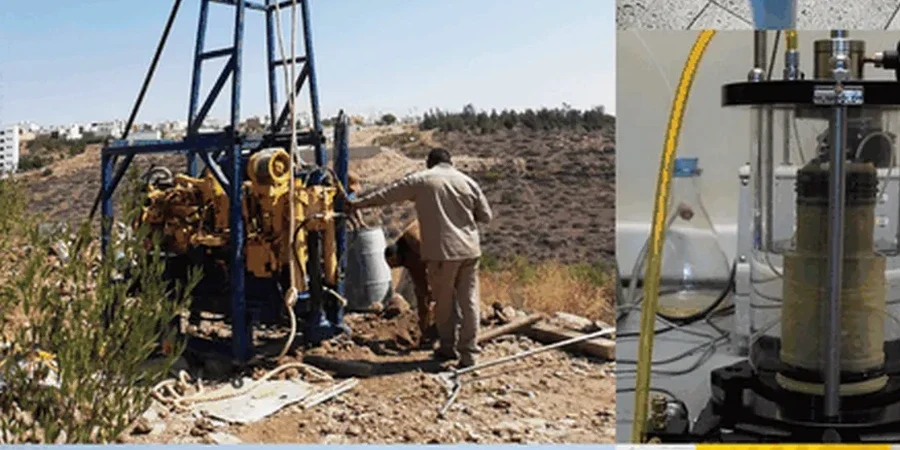
Methodology applied in Plymouth
Typical technical challenges in Plymouth
Plymouth sits at an elevation that barely reaches 20 metres AOD across much of the city centre, and its population of over 260,000 continues to press development into the Plym and Tamar floodplains. The risk picture is dominated by water. The tidal range in Plymouth Sound exceeds 5 metres on spring tides, and that fluctuation pushes groundwater levels up into the alluvial clays, reducing effective stress and triggering consolidation settlement under new loads. A soil mechanics study here must quantify the coefficient of consolidation (cv) with precision, because a misjudged pre-loading programme on a commercial building pad in the Ernesettle area, for example, could leave a developer with differential settlement and cracked service trenches. Slope instability is another live concern—the over-steepened valley sides along the Plym have a history of shallow rotational failures in the weathered slate, something our stability analyses address using effective stress parameters from the lab, incorporating pore pressure data.
Our services
A full soil mechanics study in Plymouth feeds directly into the design team’s decision-making. These are the core components we deliver:
Laboratory Testing Programme
From Atterberg limits to consolidated-drained triaxial shear, we run the full suite under our UKAS-accredited quality system. Classification tests (wL, Ip, PSD) are standard, but we often push further with oedometer consolidation and ring shear for landslide-prone sites on the Plym valley slopes.
Foundation Design Parameters
We translate the ground investigation data into an interpretative report that gives the structural engineer direct inputs: allowable bearing pressures for pad and strip footings, modulus of subgrade reaction for raft design, and shaft friction values for piled options in the transition zone between the alluvium and the underlying limestone bedrock.
Quick answers
How much does a soil mechanics study cost for a Plymouth site?
A comprehensive soil mechanics study in Plymouth, including field investigation, lab testing, and an interpretative report to BS EN 1997, typically ranges from £2,780 to £4,210. The final figure depends on the number of exploratory holes, the depth to competent strata, and the complexity of the lab schedule required to characterise the Made Ground and natural soils properly.
What is the difference between a soil mechanics study and a standard site investigation?
A site investigation provides the raw data—borehole logs, SPT N-values, and sample descriptions. A soil mechanics study takes that data and applies constitutive models to predict how the ground will behave under load. It includes advanced lab testing like triaxial and oedometer tests to derive parameters such as angle of shearing resistance and constrained modulus, which the structural engineer needs for Eurocode 7 design.
Do you need to test for chemical aggressiveness in Plymouth’s soils?
Yes, particularly on brownfield sites and near the historic dockyards. The fill material in areas like Devonport and Millbay often contains ash, clinker, and industrial residues that produce elevated sulphate and low pH. We routinely specify chemical analysis to BRE SD1 to determine the Design Sulphate Class and recommend appropriate concrete mix designs to avoid long-term degradation of buried structures.
How long does it take to get results from the lab for a Plymouth project?
Classification tests like moisture content and Atterberg limits can be turned around within 3 to 5 working days. However, strength and consolidation tests—triaxial and oedometer—require longer curing and shearing stages, so we typically schedule lab reports for 10 to 15 working days from sample receipt. We coordinate with the drilling crew to prioritise samples from critical layers to keep the project programme on track.