Plymouth sits on a geological transition zone: Lower Devonian slates and siltstones to the north give way to Middle Devonian limestone around the Hoe and tidal mudstone formations along the Plym and Tamar estuaries. That mixed ground, combined with a water table that often sits less than 2 metres below the surface in areas like Sutton Harbour, makes raft and mat foundation design a necessity rather than an option. Where bearing pressures from isolated footings would overstress the upper strata, a rigid raft spreads the structural load across a much wider footprint, bridging localised soft spots. The British Geological Survey logs show variable rockhead depth across the city—sometimes striking competent limestone at 1.5 metres in Millbay, sometimes drilling through 4 metres of alluvial clay before hitting slate in Estover. Our team reads that ground variability and translates it into a foundation geometry that works, using our CPT testing data to map stiffness profiles before setting the raft thickness.
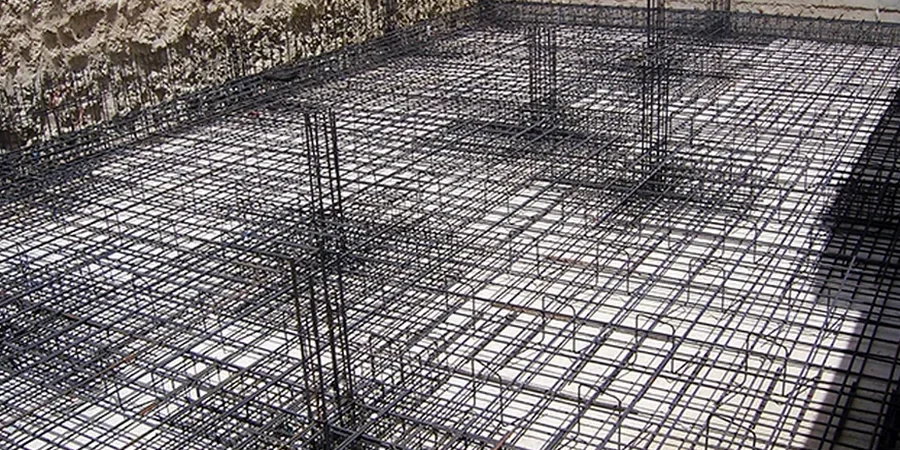
A well-designed raft turns Plymouth's variable rockhead into an asset: the slab bridges the soft spots and bears on the competent stone.
Methodology applied in Plymouth
Working video
Typical technical challenges in Plymouth
Plymouth's population of over 260,000 is concentrated on a coastal strip where the risk of differential settlement is not theoretical—it is measured in millimetres per metre across some of the city's post-war expansion zones. The greatest hazard in raft foundation design here is underestimating the compressibility of the tidal flat deposits that underlie parts of the city centre and the Barbican. A raft that is too thin or insufficiently reinforced will crack at the points where the limestone subcrop transitions to estuarine silt. We model the soil-structure interaction using the coefficient of vertical subgrade reaction derived from site-specific data, then check the serviceability limit state for total and differential settlement against the tolerances of the superstructure. On sites with a mining legacy—Plymouth's limestone quarries and the old tin and copper workings towards Dartmoor—we combine the raft design with a thorough desk study and targeted probe drilling to rule out crown holes before the pour.
Our services
Our raft and mat foundation service in Plymouth covers the full design chain—from ground investigation specification through to reinforcement detailing and construction phase supervision. Every design package includes a geotechnical interpretative report, a detailed structural calculation pack, and a set of fully dimensioned drawings ready for building control submission.
Full Raft Foundation Design Package
Complete structural and geotechnical design of raft and mat foundations for residential and commercial structures in Plymouth. Includes site-specific ground model, finite element analysis of soil-structure interaction, bending moment and shear force envelopes, and full reinforcement detailing to BS EN 1992-1-1. We deliver a calculation pack and construction drawings within 10 working days of receiving the ground investigation report.
Ground Investigation & Site Supervision
Specifying, managing, and interpreting the ground investigation needed for a reliable raft design on Plymouth's variable geology. We arrange cable percussive boreholes, trial pits, and in-situ plate load tests; log the cores against the BGS lexicon; then supervise the raft pour to confirm blinding, reinforcement placement, and concrete cover meet the specification.
Quick answers
What does a raft foundation design cost for a project in Plymouth?
For a typical single-dwelling raft or a small commercial mat foundation in the Plymouth area, the design fee ranges from £920 to £3,710 depending on the structural complexity, number of columns, and the extent of ground investigation data already available. A project on sloping ground or within the Mining Reporting Area will fall towards the upper end due to the additional modelling and risk assessment required.
When is a raft foundation better than strip footings in Plymouth?
A raft becomes the better solution when the near-surface ground has low or highly variable bearing capacity—common on the alluvial silts along the Plym and Tamar corridors. If the allowable bearing pressure drops below 75 kPa, or if the total settlement of isolated footings would exceed 25 mm, a raft spreads the load and reduces differential movement. It also works well where the water table is high, eliminating the need for deep excavations that would require dewatering.
How do you verify that the raft design will perform on Plymouth's mixed ground?
We verify performance through a three-stage process. First, we commission or interpret a site-specific ground investigation with in-situ testing—typically plate load tests or CPT soundings—to measure the actual stiffness of the soil, not an assumed value. Second, we model the raft as a flexible plate on an elastic continuum using the derived subgrade reaction modulus, checking both the ultimate limit state (bending, shear, punching) and the serviceability limit state (total and differential settlement). Third, during construction we inspect the formation level to confirm that the ground conditions match the design assumptions before the blinding concrete is poured.