Most subgrade failures we see in Plymouth come back to one thing: water. The Devonian slate and head deposits common across the city drain poorly, and the maritime humidity doesn't help. A standard laboratory CBR test with a 4-day soak in BS EN 13286-47 conditions reveals exactly how much strength the formation loses when saturated. We run these tests in our UKAS-accredited lab, not a third-party facility, so we control turnaround and can get results to your pavement designer within a week. For deeper formation assessment we often combine this with in-situ permeability testing on site, because drainage governs long-term subgrade performance here more than the initial dry strength. Plymouth's coastal exposure means pavement layers work harder than inland equivalents — salt spray, high water tables and tidal groundwater fluctuations all demand a conservative CBR value you can trust.
A soaked CBR of 2% versus 5% changes the pavement thickness by 100 mm or more — in Plymouth's variable ground, that difference shows up between boreholes 50 metres apart.
Methodology applied in Plymouth
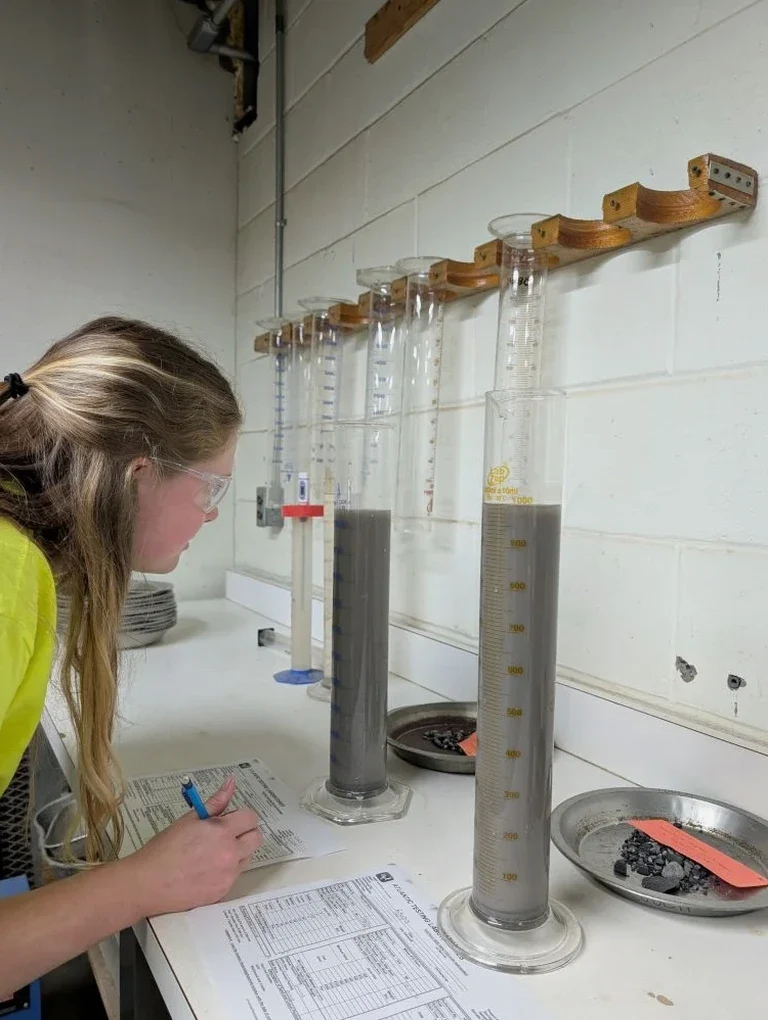
Typical technical challenges in Plymouth
The CBR mould goes into the soak tank and we check it every 24 hours. Swelling can be dramatic in Plymouth's clay-rich head deposits — we've recorded vertical swell exceeding 5 mm in the first day alone. That's a subgrade that will heave under a pavement if it's not addressed. The bigger risk is skipping the soak entirely. A CBR test run at placement moisture gives a number that looks fine on paper — 8%, 10%, maybe 12%. But if the formation sits on a perched water table in Mannamead or Peverell and saturates over winter, the true CBR drops to 1% or less. The pavement fails within two seasons. We report both the soaked CBR at top and bottom of the specimen and the swelling curve so the designer sees the full behaviour, not just a single number.
Our services
Our Plymouth laboratory runs CBR testing as part of a complete pavement investigation package. We coordinate sampling, transport and testing under one quality system.
Soaked CBR to BS EN 13286-47
Standard 4-day soak with surcharge, swelling monitoring and penetration testing at three compaction efforts. Report includes CBR vs density curve and moisture content data.
Combined subgrade investigation
CBR testing paired with Atterberg limits and particle size distribution from the same bulk sample. Gives the pavement designer plasticity index, grading and strength in one report.
Expedited pavement design support
Soaked CBR results within 5 working days of sample receipt. We supply the design CBR value with commentary on variability across the site for input to HD 26/06 or local specification.
Quick answers
How long does a soaked laboratory CBR test take?
The soak period is 96 hours as required by BS EN 13286-47. Sample preparation and compaction takes one day, soaking runs four days, and penetration testing plus reporting takes one more day. Expect results within 5 to 6 working days from sample receipt.
What sample size do you need for a laboratory CBR test?
We need approximately 25 kg of disturbed bulk sample per CBR test point. The material should be representative of the formation at the target compaction depth. We can advise on sampling procedure before your trial pit or borehole programme.
What does a laboratory CBR test cost in Plymouth?
A single-point soaked CBR test to BS EN 13286-47 typically costs between £110 and £170 depending on the number of compaction efforts and whether swell monitoring is required. Package pricing applies when multiple specimens are tested from the same formation.
Why do CBR values in Plymouth vary so much between sites?
The geology changes rapidly across the city. Plymstock and Pomphlett sit on Devonian limestone with high CBRs. The city centre and areas north of the A38 are underlain by head deposits — silty, clay-rich material that loses significant strength when saturated. A CBR of 15% in Plymstock can drop to under 3% in Mutley Plain on the same project.
Can you test stabilised subgrade materials?
Yes. We test cement-stabilised and lime-stabilised subgrades using the same CBR procedure, typically after a curing period specified by the designer. The soaked CBR of a stabilised formation often exceeds 30% and can reach 80% or more depending on binder content and curing conditions.