Plymouth’s expansion from a medieval port into a major naval city has left a complex subsurface legacy, particularly in areas like Millbay and Stonehouse where old quays and reclaimed land sit alongside natural limestone headlands. The reconstruction after the Blitz reshaped entire neighbourhoods, and each new development now rests on ground that demands a careful reading of its stratigraphy. A CPT test provides a continuous profile of the soil column, distinguishing between the weathered Upper Devonian slates, pockets of estuarine alluvium, and the granular fills that cap much of the city centre. For geotechnical engineers working on Plymouth Sound’s waterfront, the cone penetrometer is often the first tool deployed to map soft clay layers before any deep excavation is planned, because the transition from competent rock to compressible sediment can be abrupt and unpredictable in this part of Devon.
A single CPT sounding in Plymouth’s estuarine deposits can replace three or four boreholes when the goal is a continuous stratigraphic profile—the data density is what makes the method indispensable.
Methodology applied in Plymouth
Typical technical challenges in Plymouth
A project near the Royal William Yard involved a proposed five-storey residential block on ground that historical maps showed as a former tidal inlet filled in the 19th century. The developer’s initial desk study assumed competent gravel over bedrock, but the first CPT sounding told a different story: six metres of loose, unconsolidated fill over soft organic silt, with tip resistance barely reaching 2 MPa until a depth of nine metres. Had that profile gone undetected, a conventional shallow footing system would have settled differentially within the first winter of storm surge. The CPT data forced a redesign to a pile foundation driven into the limestone, adding upfront cost but preventing a structural failure that would have multiplied expenses tenfold. In Plymouth’s reclaimed zones—from the Barbican’s old quaysides to the infilled creeks along the Plym—this scenario repeats itself regularly, and the cone penetrometer remains the most reliable tool for catching it early.
Our services
Our Plymouth CPT service covers the full investigation workflow, from mobilisation planning on restricted city-centre sites to final data interpretation in formats compatible with AGS 4.0 and common geotechnical software.
Piezocone (CPTu) Profiling
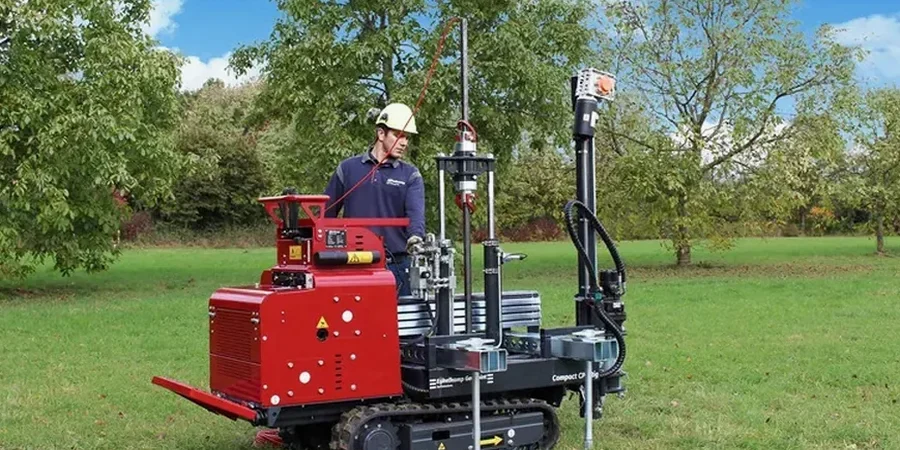
A 20-tonne tracked rig with electronic piezocone, logging tip resistance, sleeve friction, and pore pressure at 2-cm intervals. Ideal for mapping soft alluvium layers beneath Plymouth's waterfront developments and estimating undrained shear strength profiles without sampling.
CPT Data Interpretation and Reporting
Soil behaviour type classification using Robertson (1990) and Lunne et al. charts, derivation of equivalent SPT N60 values, constrained modulus for settlement calculations, and liquefaction potential screening for sites near the Plym estuary.
Quick answers
How much does a CPT test in Plymouth cost?
A standard CPT sounding in the Plymouth area typically falls between £140 and £210 per metre of penetration, depending on access conditions, depth to refusal, and whether pore pressure measurement (CPTu) is required. Mobilisation is usually quoted separately and depends on the number of soundings per visit—a single-day programme with two to three points spreads the rig transport cost more efficiently.
Can a CPT rig access a confined site in Plymouth's older neighbourhoods?
Yes, we operate compact tracked CPT rigs that can pass through a 1.2-metre-wide opening, which covers most terraced-house alleyways in areas like Stoke and Devonport. For basement excavations or interior slabs we use a mini-rig with a total height under 2 metres. Access is always surveyed before mobilisation to confirm ground bearing capacity for the tracks.
How does CPT compare with SPT drilling for Plymouth's geology?
In the soft estuarine silts and loose made ground common around Plymouth Sound, CPT gives a far more continuous and repeatable profile than SPT—sampling every 2 cm instead of every 1.5 m. SPT has the advantage of recovering a physical sample, so on sites with mixed fill containing rubble or cobbles we often run both methods: CPT for the stratigraphy, and an SPT borehole where the cone hits refusal or we need to see the material.
What standard do you follow for CPT testing and reporting?
All CPT soundings are performed to BS EN ISO 22476-1, with calibration certificates traceable to UKAS-accredited laboratories. Our reporting references BS 5930 for soil description and Eurocode 7 (BS EN 1997-2) for the derivation of geotechnical parameters, and we deliver data in AGS 4.0 format as standard so it integrates directly with your geotechnical consultant's systems.