Plymouth’s geology shifts dramatically as you move from the hard Devonian limestone of the Hoe toward the alluvial deposits behind Sutton Harbour. A foundation that works well on the bedrock ridge can encounter completely different ground just half a mile away in areas like Cattedown, where buried river channels filled with soft estuarine clays create conditions that amplify seismic motion. This contrast is precisely why base isolation seismic design requires more than just a standard approach here. The team’s background across Plymouth Sound and the Tamar Valley shows that a detailed ground investigation is the only way to determine whether a lead-rubber bearing or a friction pendulum system will perform as intended. We often combine early-stage test pits with deeper boreholes to map the interface between the weathered limestone and the intact rock, since this transition zone heavily influences the dynamic response of any isolated structure. Without that resolution, even a well-designed isolation system can underperform when the ground motion arrives at an unexpected frequency.
In Plymouth, the combination of buried valley sediments and coastal seismicity demands that base isolation systems be tuned to site-specific ground motion, not generic hazard maps.
Methodology applied in Plymouth
Typical technical challenges in Plymouth
Eurocode 8 Part 1 (BS EN 1998-1:2004) and its UK National Annex frame the requirements, but applying them in Plymouth means confronting the legacy of historic mining and uncharted backfilled docks. The city’s expansion over centuries has left voids and poorly compacted fill that can concentrate strain at the isolation plane, potentially leading to differential settlement under seismic loading. When an isolation system is specified without verifying the continuity of the bearing stratum beneath the entire footprint, the risk of torsional response increases significantly. Our investigations pay close attention to the transition between the Plymouth Limestone and the overlying Head deposits, because abandoned mine shafts and solution features in the limestone present a collapse hazard that must be mitigated before isolator installation. The presence of radon in parts of the city also influences basement and crawl space design, which interacts with the isolation interface detailing.
Our services
Our base isolation seismic design service in Plymouth is built around the specific geological and climatic conditions of the South West. Each project starts with a thorough characterisation of the site, followed by isolator selection, non-linear analysis, and peer review.
Site-specific seismic hazard assessment
We develop uniform hazard spectra for Plymouth sites using UK probabilistic models, incorporating local soil amplification from borehole data and shear wave velocity profiles.
Isolator selection and performance verification
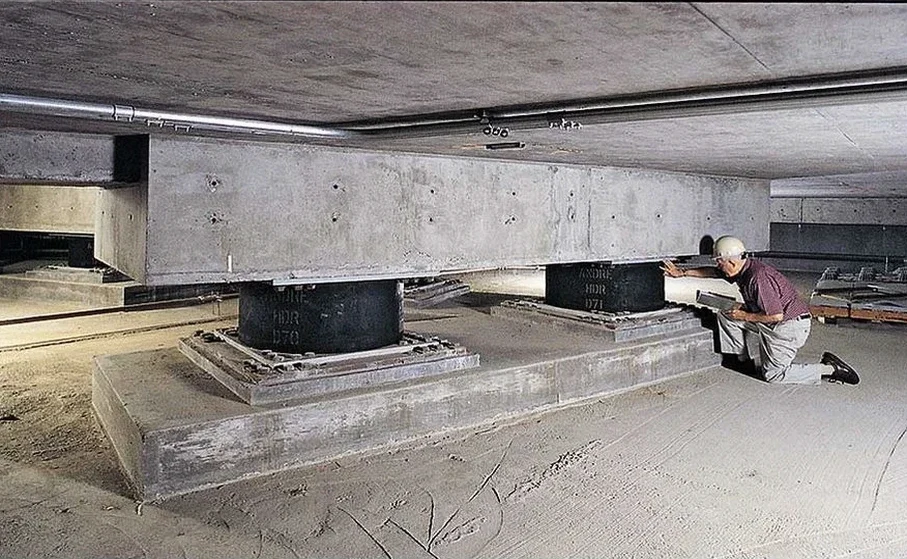
Our team evaluates lead-rubber, high-damping rubber, and friction pendulum options against project displacement demands, long-term creep, and marine environment durability in Plymouth.
Non-linear time history analysis and peer review
Using ground motions matched to the target spectrum, we model the full structure-isolator system to verify performance for both the service level earthquake and the maximum considered event.
Quick answers
What ground conditions in Plymouth make base isolation seismic design particularly challenging?
The main challenge is the abrupt change from hard Devonian limestone to soft estuarine clays in buried valleys around Sutton Harbour and the Plym estuary. These soft soils can amplify ground motion at periods that affect mid-rise buildings, so the isolation system must be tuned carefully. We also contend with historic backfill, abandoned mine workings, and a high water table that influences isolator buoyancy and corrosion protection requirements.
What is the typical cost range for base isolation seismic design on a Plymouth project?
For a preliminary design package including site investigation interpretation, isolator selection, and non-linear analysis, fees typically range from £2,930 to £6,620 depending on the structural complexity and the number of ground motion records analysed. A full detailed design and peer review for a larger building would fall at the upper end of that range.
Which British and European standards apply to base isolation projects in Plymouth?
The primary design standard is BS EN 1998-1:2004 (Eurocode 8) with the UK National Annex. Ground investigation follows BS 5930:2015, and the geotechnical design aspects are covered by BS EN 1997-1:2004 (Eurocode 7). For isolator testing, we reference EN 15129, and durability in Plymouth's marine environment is addressed through BS EN ISO 12944 for corrosion protection.