When you are working on a site in Plymouth, the ground is rarely straightforward. The city sits on a complex transition zone between Middle Devonian limestone, slates, and the tidal influence of the River Plym and Tamar estuaries. BS 5930 and Eurocode 7 (BS EN 1997-1:2004) govern the ground investigation and design process, and we follow them to the letter. A pile foundation design here has to account for buried valley features, the weathering profile of the Plymouth limestone, and the potential for soft estuarine clays at depth. We do not guess. We correlate the borehole data with the geotechnical model, and then we size the piles to transfer the structural load into competent bedrock or dense granular layers. Many of our Plymouth projects link the pile design to an earlier CPT test campaign, which gives us a continuous profile of tip resistance and sleeve friction, especially useful where the limestone is fractured and the degree of weathering changes rapidly over a few metres of depth.
Plymouth limestone can hide solution cavities: we design piles spanning the void, not terminating inside it.
Methodology applied in Plymouth
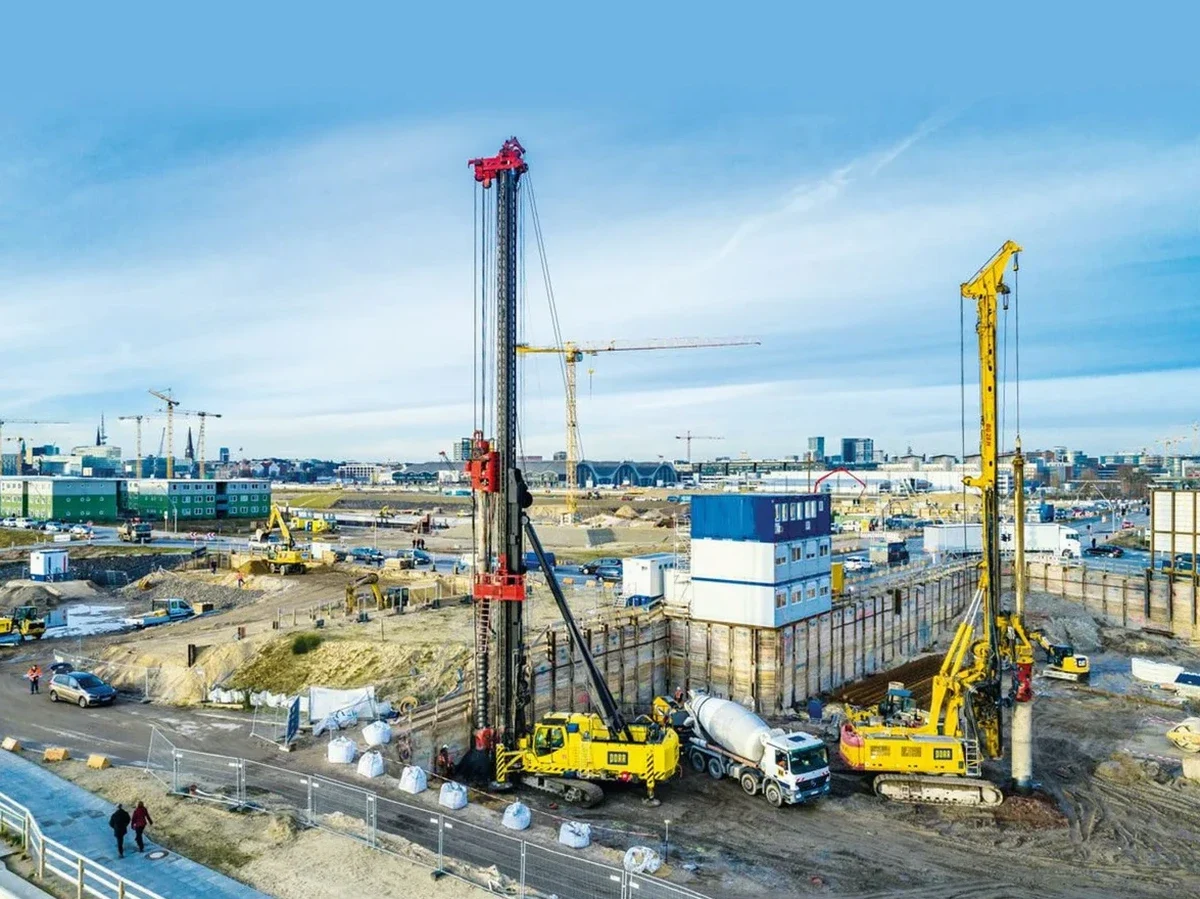
Typical technical challenges in Plymouth
The humidity from the Plymouth Sound and the tidal range of over 5 metres create a groundwater regime that fluctuates aggressively in the upper fills and fractured rock. A pile foundation design that ignores this ends up with a concrete mix that is not durable enough for the exposure class. We specify the correct water-cement ratio and minimum cement content per BS 8500 for aggressive ground conditions, and we detail the reinforcement cover to suit a 50-year or 100-year design life. Another subtle risk is the sulphide content in the estuarine clays of the Tamar valley: if the ground investigation flags pyrite, the pile concrete must be sulphate-resisting, or you will be dealing with thaumasite attack in two decades. Our designs include a note on the aggressive chemical environment and the required concrete specification, so the contractor has a clear path to compliance.
Our services
We supply pile foundation design as a standalone service or integrated with the ground investigation. The scope is tailored to the complexity of the Plymouth site.
Geotechnical pile design package
We produce the full design report with axial and lateral capacity calculations, settlement analysis, pile group efficiency, and reinforcement detailing. The output includes the pile schedule, construction specification, and a risk register for the karst features common in the Plymouth Limestone.
Pile load test specification
For larger projects we write the static load test specification, supervise the test on site, and interpret the load-settlement curve to validate the design assumptions. This is particularly valuable in the Millbay and Stonehouse areas where the ground model has more uncertainty.
Quick answers
What is the typical cost range for a pile foundation design in Plymouth?
For a standard residential or small commercial building in Plymouth, the design fee typically falls between £1,410 and £4,280, depending on the number of piles, the complexity of the ground profile, and whether a load test is required. A site with karst features or a deep soft clay layer will be at the higher end because the analysis is more iterative.
How do you handle the solution cavities in Plymouth limestone?
We first map the rockhead and any voids using a combination of rotary coring and geophysics, usually seismic refraction or cross-hole tomography. The pile design then either bridges the cavity by socketing deeper into competent rock, or we treat the void with low-strength grout before piling. The decision comes from a risk assessment of the cavity size and the structural loads.
Do you need a separate ground investigation before the pile design?
Yes, a ground investigation to BS 5930 is essential. We can recommend the scope — boreholes, CPTs, rotary cores — but we need site-specific data on the stratigraphy, groundwater, and rock strength to produce a Eurocode 7 compliant design. We do not design piles from desk study data alone.