The ground beneath Plymouth tells two very different stories depending on where you stand. Up on the limestone plateau around Mutley Plain, a metre of excavation might hit solid Devonian limestone before you've really got started. Yet down by Sutton Harbour and the Barbican, you could dig three metres and still be pushing through soft estuarine silts and made ground that remembers centuries of maritime industry. This geological split shapes everything about how we approach a ground investigation in Britain's Ocean City. An exploratory test pit programme bridges that gap between what a desk study suggests and what the ground actually delivers, exposing stratification, groundwater conditions, and obstructions that boreholes sometimes miss. In Plymouth's mixed terrain, where weathered shale transitions into head deposits without warning, trial pitting remains one of the most direct ways to observe foundation conditions before committing to a structural design. Our background across Plymouth's postcodes, from the alluvial clays of the Plym Valley to the granitic soils edging onto Dartmoor, means we know where to dig and, more importantly, what to look for once the bucket opens the ground. For deeper profiling beneath the weathered zone, exploratory pits often pair naturally with CPT testing to extend the investigation depth.
A well-logged test pit in Plymouth's head deposits reveals more about foundation conditions in twenty minutes than a desk study delivers in two weeks.
Methodology applied in Plymouth
Typical technical challenges in Plymouth
Plymouth's post-industrial landscape hides a particular risk that only boots-on-the-ground background reveals: undocumented fill. Around Millbay Docks and the old gasworks sites near Stonehouse Creek, we have opened test pits expecting natural ground at two metres and instead found brick rubble, clinker, and occasionally hydrocarbon-stained soils extending well past three metres depth. These materials are not just a digging hazard; they change the ground model completely. An exploratory test pit that penetrates this fill layer provides the first reliable estimate of its thickness and lateral extent, which directly impacts decisions on shallow foundations versus piling. On the limestone slopes running up towards Compton and Mannamead, another risk emerges: solution features and clay-infilled fissures in the rockhead that create differential settlement zones invisible from the surface. A pit excavated to refusal on the limestone lets the engineering geologist inspect the rockhead condition, measure the infill depth, and recommend whether to dig out the soft material or design the foundation to span across it.
Our services
Our Plymouth exploratory test pit service covers the full investigation cycle, from initial utility clearance and excavation through to laboratory testing and factual reporting. Each pit is treated as a small-scale investigation in its own right.
Machine-excavated trial pits with geotechnical logging
Tracked excavator trial pitting to depths up to 4 metres, with continuous logging by an engineering geologist to BS 5930. Includes in-situ strength testing, seepage observation, and photographic record of each pit face before backfill.
Disturbed and undisturbed sampling programme
Block samples cut from pit faces for triaxial and oedometer testing, plus bulk disturbed samples from each distinct stratum for classification, chemical testing, and contamination screening where historical land use warrants it.
Combined exploratory pit and dynamic probing investigation
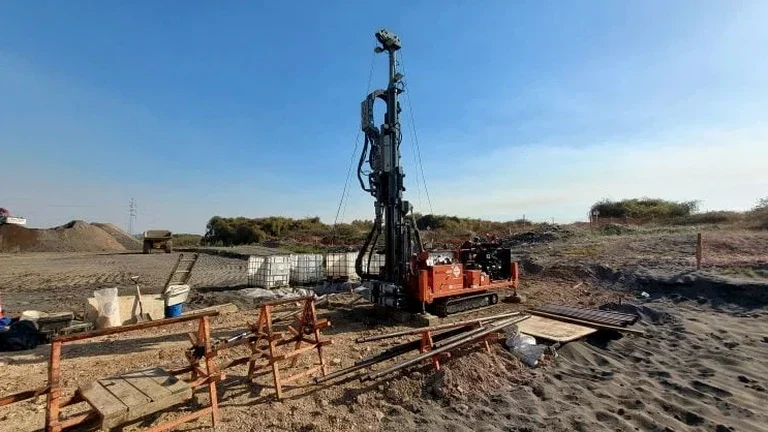
Where pits reach refusal on shallow rockhead but deeper profiling is needed, we supplement with dynamic probing or window sampling boreholes from the same mobilisation, building a continuous ground model from surface to target depth.
Quick answers
What depth can an exploratory test pit reach in Plymouth's ground conditions?
In the limestone and head deposit terrain typical of Plymouth, machine-excavated pits routinely reach 3.5 to 4.0 metres below ground level. Depth is limited by excavator reach, trench stability, and groundwater ingress. Where the water table is high, as it often is in the estuarine deposits near the Plym and Tamar estuaries, pit depth may be restricted to around 2.5 metres before inflows make safe working impractical. For deeper profiling we supplement pits with borehole or CPT techniques.
How long does a typical test pit investigation take on site?
A single exploratory test pit excavated and logged to BS 5930 standard typically takes between 45 and 90 minutes, depending on depth, strata complexity, and sampling requirements. A programme of four to six pits across a Plymouth residential or commercial site can usually be completed in a single working day, assuming access is clear and underground solutions have been located beforehand.
What is the cost range for exploratory test pits in Plymouth?
For a standard machine-excavated test pit programme in the Plymouth area, costs typically range from £350 to £750 per pit, including mobilisation, excavation, geotechnical logging, sampling, and backfill. The final figure depends on access constraints, pit depth, number of pits, and whether laboratory testing is required. A site-specific quotation is always provided after reviewing the desk study and site layout.
Are test pits suitable for investigating contamination on brownfield sites?
Yes. Exploratory test pits are widely used for preliminary contamination assessment on Plymouth's brownfield land, particularly around former industrial areas like Cattedown and Millbay. The exposed pit face allows visual identification of staining, odours, and waste materials. Soil samples can be taken for chemical analysis in UKAS-accredited laboratories. However, test pits disturb the ground significantly; for precise contamination delineation, window sampling boreholes may be more appropriate.
What safety measures apply to deep test pits under UK regulations?
Under CDM 2015, any excavation deeper than 1.2 metres requires a temporary works design, shoring, benching, or battering to prevent collapse. Our Plymouth test pit operations include a site-specific risk assessment, CAT and Genny scanning for buried solutions before digging, gas monitoring where ground contamination is suspected, and a trained banksman throughout the excavation. No personnel enter pits deeper than 1.2 metres unless a engineered support system is in place and inspected.